


Christmas Installations for Private Residences

Amaranté designs and installs Christmas schemes in private homes across London and the UK. Trees dressed to a scheme rather than a box of baubles, garlands that follow the architecture, entrances, staircases and tablescapes. Planning usually begins three to four months before installation, and everything comes down in the first two weeks of January.
Most homes do not need more decoration. They need fewer things, done properly, in the places that actually carry the room. That is the difference between a house that looks decorated and a house that looks designed.











What we design and install in a private home
The tree, dressed to a scheme.
Not a theme out of a box. A palette, a material, and a consistent idea repeated at scale, chosen against your interior rather than against what is in the shops that year. Real or faux, and that decision changes the rest of the plan, so it is one we make early.
Garlands and natural detailing.
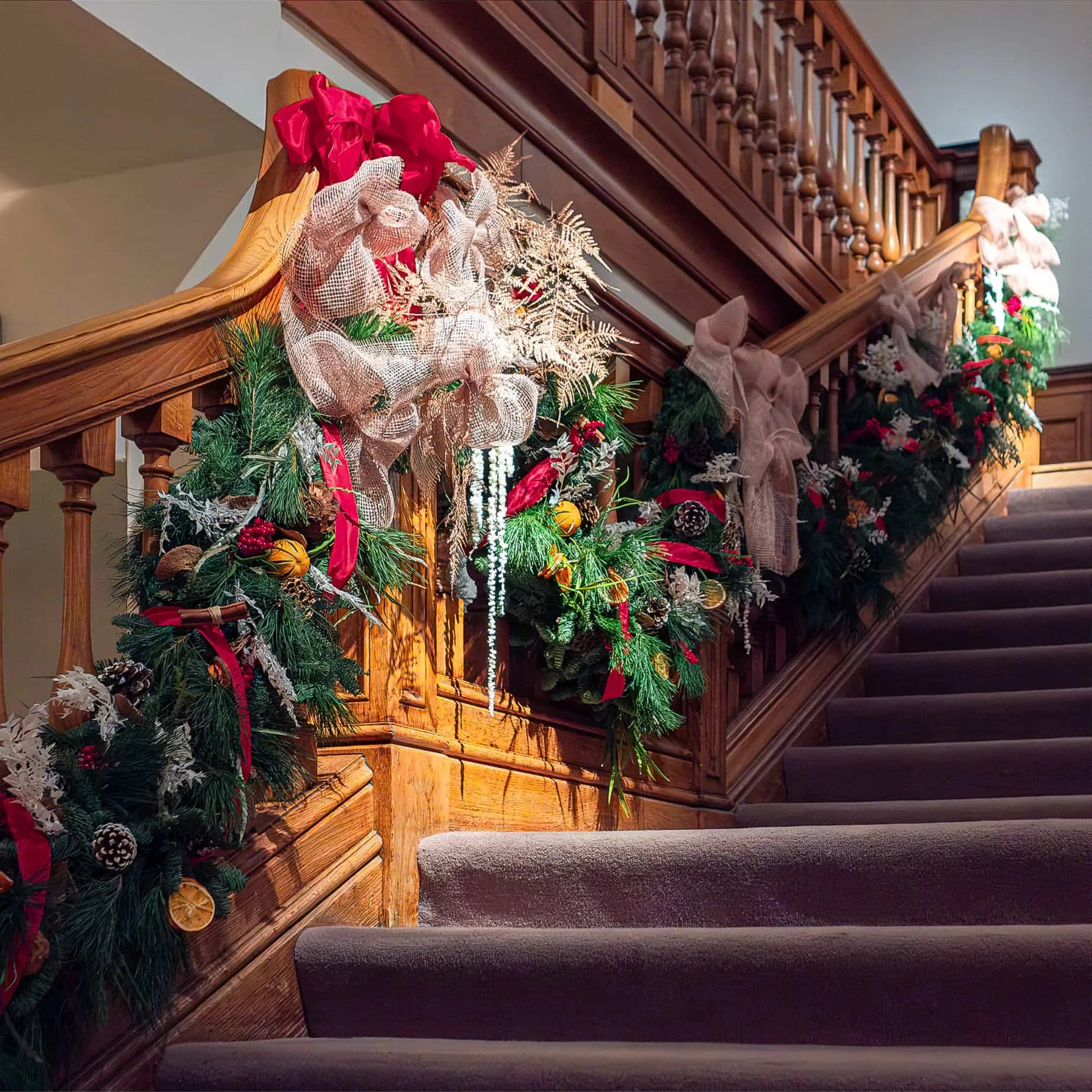
Mantelpieces, banisters, door frames, kitchen islands, the places the architecture already leads the eye. A garland that follows a staircase is doing the house's own work for it, which is usually better value than a free standing display.
Entrances, staircases and windows.
The first six feet inside the door set the tone for everything behind them. For a house that will be photographed, or that is hosting, this is where the budget earns the most.
Tablescapes and festive styling.
Christmas lunch, a drinks party, a long weekend of people staying. A seated table can carry height because nobody is reaching across it. A standing drinks table cannot, because every surface is competing with glasses.
Wreaths.
For the front door, internal doors, and increasingly for windows seen from the street.
Feature installations.
A single designed piece in a double height hall, above a stairwell, or in a garden room. Where something is fixed to the building, the fixing method is agreed with you in advance and in writing, because it is your house and your decision.
Full festive production,
where all of the above runs as one scheme across the whole house, with maintenance through December and a booked removal date in January.
If you are reading this in November
Shorter timeframes are welcome and regularly taken on, and the team will always find a way to make the date work. What the extra notice buys you is choice: first pick of installation dates around your plans, and the time to build something more ambitious. The later it gets, the more the diary does the choosing.
If the house needs to be ready for a date in December, the conversation should happen this week rather than next month.

When to start planning your Christmas installation
Planning conversations usually begin three to four months before installation. For a scheme going in during November, that means a first conversation in late summer or early September. Fully bespoke work, where pieces are designed around a particular space rather than selected from a range, is specified between April and July.
If the house needs to be ready for a date in December, the conversation should happen this week rather than next month.
| Stage | When | What happens |
|---|---|---|
| Planning conversations begin | 3 to 4 months before installation | Where most private clients start |
| Enquiry and site visit | Late summer to early September | The comfortable window. Larger installations need a visit to measure up and understand the house |
| Concept and presentation | 1 to 2 weeks after the site visit | Sketches and a scheme to react to, before anything is committed |
| Bespoke production | 2 to 4 weeks before installation, longer for larger builds | Bespoke elements are signed off and made. The bigger the build, the earlier the design is locked |
| Installation | Mid October through November | On a date and a window agreed with you or your house manager |
| Maintenance | Through December | Keeping the scheme looking the way it did on the first morning |
| Removal | First and second week of January | Always. The date is agreed when the installation is booked |

How it works, from first call to January
The conversation.
What the house is for over Christmas. Whether you are hosting, how many, which rooms people will actually be in, and whether anyone is staying. A house being photographed and a house hosting twenty people for lunch want different things.
The visit, or the photographs.
Larger installations need a site visit to measure up and read the space. Smaller schemes can usually be designed from photographs and floor plans. If you are sending photographs, take them in the light the rooms are normally used in, include the ceilings, and add one wide shot from each doorway.
Concept and sketches.
One to two weeks after the visit, you see the scheme before anything is ordered. Palette, materials, what sits where, and what it will look like at night as well as in daylight.
Installation.
Mid October through November, on an agreed date. We bring everything with us and take the packaging away the same day.
Through December.
Fresh material is checked and replaced where it needs to be. This is what separates a scheme that still looks deliberate on the 23rd from one that visibly gave up in week two.
January.
Removal in the first or second week, on the date booked back in the autumn. Anything being kept for next year is packed properly and left where you want it.
Working around a household
A private home is not a venue. The people living in it are the reason the work exists, and the installation should be the least disruptive part of the season rather than another thing to manage.
You get one named contact, not a general inbox, from the first conversation through to removal in January.
The access window is agreed with you, or with your house manager, estate manager or interior designer if you would rather it ran through them. We work to your day rather than asking you to work around ours.
We bring everything and take the packaging with us. Nobody should be dealing with boxes and offcuts after a Christmas installation.
Nothing is published without your explicit permission. Our Christmas work for hotels, restaurants and retail is on the site because those clients want it there. A private home is different: nothing appears on our website, our social media or in press without your explicit permission, and we never name our private clients.

What comes back next year, and what does not
This is worth deciding at the design stage rather than on removal day, because it changes what the scheme is built from.
Fresh material cannot be kept. It is at its best for the season and then it is finished.
Preserved, dried and faux elements can be. They are packed properly at removal and left wherever you want them stored. Preserved roses in particular hold for years rather than weeks: our infinity roses last up to three years with care, kept dry and out of direct sunlight.
Building a scheme in layers is the practical answer for most houses. A permanent structural layer that returns each year, and a fresh layer that changes, so the house does not look identical every December and you are not paying for the whole thing twice.
A London house and a country house, or a main residence and somewhere you only arrive at in late December, can run as one scheme with two installation dates. One brief, one palette, one point of contact, two visits.
It takes longer to plan than a single property, so it wants an earlier conversation. If the second house is somewhere you arrive at only days before Christmas, say so at the first call, because it changes the order the work is scheduled in.


Why Clients Stay With Us
Frequently asked questions
Three to four months before installation. In practice that means August or September for a home dressed in November. Bespoke pieces are signed off and made in the two to four weeks before installation, longer for larger builds, so the more ambitious the scheme, the earlier the conversation should start.
No, but the choice narrows. Shorter timeframes are taken on. What changes is the installation date available to you and how bespoke the scheme can be.
There is no useful single figure, and anyone quoting one before seeing the house is guessing. The quote is driven by the number of rooms, the scale of each piece, whether material is fresh or preserved, whether anything is being designed from scratch, and whether December maintenance is included. A budget range at the first conversation gets you an accurate proposal first time.
Larger installations do, to measure up and understand the space. Smaller schemes can usually be designed from photographs and floor plans.
The first or second week of January, on a date agreed when the installation is booked.
Yes, and the tree is part of the scheme rather than bought separately and decorated afterwards. Whether it is real or faux is decided early, because it affects maintenance and what can be kept for next year.
Preserved, dried and faux elements can be kept and are packed properly at removal. Fresh material cannot. If reuse matters, say so at the design stage, because it changes what the scheme is built from.
Yes. Amaranté dresses over 100 venues a year across London and the UK. The studio is in Stratford, East London.
Never without your explicit permission, and we never name our private clients. Nothing is published unless you choose to share it.
Yes, and it often works better that way. Tell us at the first conversation who holds the decision and who holds the diary, because they are not always the same person.
Start the conversation
The useful first step is a short conversation about the house, the dates and who is coming, before any design exists. That conversation decides more than the styling does.

We Can Help With Your Event
If you’re planning a spectacular event and would like to find out more about how we partner with clients to create large scale, multi-day events like this, please fill out the enquiry form below to organise a consultation with our team.